

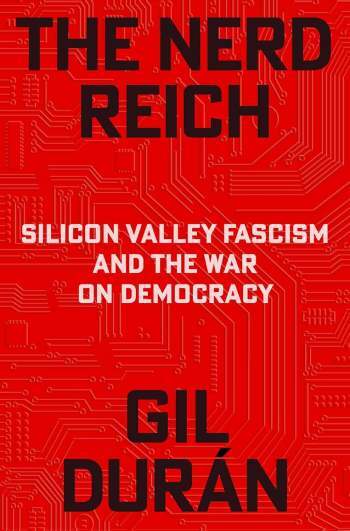
“The Nerd Reich”: Author Gil Durán on Big Tech Fascism, Peter Thiel, JD Vance & the War on Democracy
Story August 17, 2026
A new book by longtime Bay Area journalist Gil Durán investigates “tech fascism” and its mounting influence on U.S. politics. The Nerd Reich: Silicon Valley Fascism and the War on Democracy follows the rise of Vice President JD Vance, the former venture capitalist whose “outsider” campaign for Senate was bankrolled by the billionaire co-founder of PayPal and Palantir, Peter Thiel. Durán traces the ideological lineage of the current Trump administration back from Vance to Thiel and the far-right-wing monarchist Curtis Yarvin, whose “right-libertarian” political theory has long made the rounds among Silicon Valley elite. “These guys were never libertarians,” says Durán. “Now that they are the government, we see their true face: They’re fascists, and they’re authoritarians.”
AMY GOODMAN: This is Democracy Now!, democracynow.org, The War and Peace Report. I’m Amy Goodman, with Anjali Kamat.
ANJALI KAMAT: The Nerd Reich: Silicon Valley Fascism and the War on Democracy. That’s the name of a new book by our next guest, the journalist Gil Durán. The book looks at how tech billionaires, including Peter Thiel and Elon Musk, are pushing what Durán calls “tech fascism.”
Gil Durán also documents how Thiel had played a pivotal role in JD Vance’s rise to power. Durán writes, quote, “Vance is almost entirely a creation of Thiel who bankrolled his brief stint as a Silicon Valley venture capitalist and United States senator. With Vance at Trump’s side — Silicon Valley had one of their own in the White House — a tech venture capitalist one heartbeat away from the presidency.”
AMY GOODMAN: Gil Durán joins us here in New York. He’s the former opinion editor of The Sacramento Bee and editorial page editor at the San Francisco Examiner. He now publishes two newsletters: The Nerd Reich and FrameLab.
Welcome to Democracy Now! So, let’s start with the title, The Nerd Reich: Silicon Valley Fascism and the War on Democracy. Why’d you choose it?
GIL DURÁN: Well, in 2024, I wrote a series for The New Republic about the extremist ideological beliefs coming out of Silicon Valley. And after I’d written a story that went really viral and got me under attack by one of these guys, someone reached out to me from the crypto world and said, “You know, we’ve been calling these guys 'the Nerd Reich' for years.” And that blew my mind. And I saw that no one was really using that title, and so I rebranded my newsletter, which had some boring other name, as The Nerd Reich, and that became the main message of it. But I thought it was amazing that from within their own community, this was a label that was applied to them. People understood it was fascist and was echoing Nazism in nature.
AMY GOODMAN: But I want to just say the billionaire tech bros, as they are known, another name for them, haven’t always been the way they are now, in fact, when Trump was first coming into office. Talk about how they have changed.
GIL DURÁN: During the first Trump administration, we saw something called Tech Against Trump, where there were all these tech companies standing up to Trump, filing lawsuits, opposing his crackdowns on immigration. This time around, it’s completely different.
AMY GOODMAN: He was removed from X.
GIL DURÁN: Yeah, removed from X. Facebook banned him. Now we see the opposite happening.
I think what happened is that Trump was able to tap into some undercurrents in Silicon Valley with his return to power. Billionaires had become radicalized by things like the #MeToo movement, by Occupy, by the Black Lives Matter movement, and then by the pandemic. And so, when Trump is able to return to power, they are now in a very different mentality. They’ve made billions and billions of more dollars. They’re even more against taxes and government, even though government is generally the basis for many of their fortunes.
And so, now we see a complete alignment behind Trump. In fact, Trump is being funded and supported by Silicon Valley. He wouldn’t be able to do the things he’s doing without the billions of dollars he’s raking in in open crypto corruption.
ANJALI KAMAT: You know, in the epigraph to your book, you quote Peter Thiel from 2010. So, in a way, they’ve changed, but this also goes back and has a longer history. And the end of that quote is “technology is this incredible alternative to politics.” Can you talk about what he meant by that and what that means in terms of the kind of influence Peter Thiel has?
AMY GOODMAN: And who he is?
GIL DURÁN: Yeah. Some billionaires appear to have changed, but Peter Thiel hasn’t really changed. He’s been right-wing for a very long time. Peter Thiel was born in Germany, came to the United States as a child, went to Stanford, became a lawyer, studied philosophy, and then got very lucky to be in Silicon Valley in the late 1990s as things were about to take off.
In 1997, he read a book called The Sovereign Individual, which predicted that in the 21st century technology would overthrow democracy, specifically something called cybercurrency, or what we would today call crypto, which would undermine government authority, and advanced automation, which we would call AI, which would collapse the economy by destroying most jobs and concentrating wealth in the hands of a savvy few that were called the “sovereign individual.” And Peter Thiel has credited this crazy book with being the inspiration for PayPal, which he saw — which he says was an effort to get ahead of this digital currency.
It didn’t quite work out that way, but it made him a billionaire, eventually, because it provided the basis for his fortune, and he’s been able to use his money to grow this influential cult of right-wing ideas in Silicon Valley, which, by the way, they were always there, this libertarian, it was called, vibe coming out of Silicon Valley in the '80s and the ’90s. There were a handful of writers who wrote about it then. But what we've learned is these guys were never libertarians. They just wanted to be in charge of the government. They weren’t against the government, unless they don’t get to be the government. So, now that they are the government, we see their true face: They’re fascists, and they’re authoritarians.
ANJALI KAMAT: You know, you tell this story in the book, a remarkable story, of a group of these billionaire tech bros. It’s not just Peter Thiel; it’s several other men. Can you talk about some of these other characters that you talk about? And what is their crusade against democracy?
GIL DURÁN: They have this idea, largely stemming from this Sovereign Individual book, that technology means democracy is an obsolete software system, that the United States is an obsolete country, that it won’t survive the 21st century. And I want to say, I know this sounds crazy to people, but much of my book is told in the words of these men, from — in podcasts, in interviews, in long essays, they write about it. And their problem with democracy is that they don’t get to have all the power.
ANJALI KAMAT: So, you didn’t have to get secret documents. I mean, you have some remarkable statements in this book. You have Balaji Srinivasan and also Curtis Yarvin, and Curtis Yarvin, I believe, talking about, in an early blog post perhaps, talking about San Francisco and what to do with the poor?
GIL DURÁN: Yeah. So, this idea is that they’ve got — some call it the network state. Curtis Yarvin called it “patchworks.” Part of their apocalyptic vision for the future is that the country will be broken up. It will no longer be one country. It’ll be broken up into these sort of corporate zones or fiefdoms called patchworks or network states. And the new governing structure will be these autocratic, dictator-like corporations that will have total power over their citizens. Yarvin wrote that they could even turn unproductive people into biodiesel to fuel city buses. But he said he was just kidding about that, but that what we really need for the poor is a humane alternative to genocide.
So, these are the kinds of ideas you see. And what’s disturbing is that Balaji Srinivasan, another Peter Thiel protégé, because Curtis Yarvin is funded by Peter Thiel — that’s the only reason anyone’s ever heard of him — goes on to create this idea called the network state, which is a more startup-friendly version of this, that corporations and billionaires should fund their own cities and countries. And we’re seeing that grow.
AMY GOODMAN: Let’s go to Curtis Yarvin in his own words at the Institute of Art and Ideas, where he explained why he supports monarchical system of government.
CURTIS YARVIN: Let’s debunk this concept of liberal democracy. There’s actually no such thing. Democracy in today’s world just means a good or legitimate government. It means a claim to a legitimate government. Just because you call yourself a democracy doesn’t mean anything. North Korea calls itself the DPRK, Democratic People’s Republic of Korea. That is three euphemisms for democracy, one place name, and it’s a monarchy. …
Anything that works is a monarchy. So, for example, if you take your your iPhone and you look at the box that your iPhone comes in, it says, “Designed by Apple in California, manufactured in China.” So, that is two monarchies — Apple has a CEO, and China has a dictator — and one oligarchy, which is the government of California, which is, by the way, basically a single-party state. There are no longer competitive elections in California. So, when you try to imagine the state of California, in which I live, trying to build an iPhone or design an iPhone, the concept is ridiculous.
AMY GOODMAN: Let’s go back to 2021, when JD Vance, then a candidate in Ohio for U.S. Senate, appeared on the conservative Jack Murphy Live podcast. Murphy asked Vance how to root out so-called wokeism from American institutions.
JD VANCE: There’s this guy Curtis Yarvin, who’s written about some of these things. And so, one is to basically accept that this entire thing is going to fall in on itself, right? … I tend to think that we should seize the institutions of the left and turn them against the left, right? We need — we need like a de-Baathification program, but like a de-wokeification program in the United States, right?
AMY GOODMAN: So, that was JD Vance back in 2021. The latest news, this out of The Washington Post, that President Donald Trump recently told donors in private that he wants to see his vice president, JD Vance, win the 2028 presidential election, a sign that he’s open to publicly backing JD Vance. There’s been this kind of war between JD Vance and Marco Rubio, the secretary of state. But talk about the significance of this and, as you said, JD Vance being a creation of Peter Thiel.
GIL DURÁN: JD Vance is a dangerous extremist who embraces a set of ideas that should put a chill down the spine of every American. He went on in that interview to say that Donald Trump would likely win the 2024 election, and that when he did, he should purge the federal government, just like Yarvin had recommended, and, in fact, he should defy the courts and the law and challenge the Supreme Court justices to force him to follow their dictates. It’s pretty amazing that you have a man on the political stage in the White House a heartbeat away from the presidency, who has espoused such radically anti-American ideas.
And I think people need to understand the degree to which he is so closely related to Peter Thiel. We wouldn’t have a JD Vance without a Peter Thiel. Peter Thiel is even the reason that JD Vance converted to Catholicism. He’s the reason JD Vance became a venture capitalist and a millionaire. He’s —
AMY GOODMAN: How did they hook up?
GIL DURÁN: Peter Thiel likes to go around speaking to schools and graduate schools. And in 2011, he went to Yale Law School and gave a speech. And JD Vance said it was one of the most significant moments of his life and that Peter Thiel was one of the most intelligent people he’d ever heard. And basically, that speech convinced him to not be a lawyer, and instead to become a venture capitalist. And at every step of JD Vance’s life since then, it has been Peter Thiel who has made him who he is, who has essentially created him whole cloth.
ANJALI KAMAT: And it’s not just JD Vance, right? I mean, it’s — Bloomberg, I think, reported that 16 people connected to Thiel are in the Trump administration. Can you talk about, you know, what kind of effect this has had in terms of policies? Like, you know, when we hear these ideas, they sound a little outlandish, to say the least. It’s hard to see them being translated into policy. But then, what we’ve been living over the past two years, you’re seeing a lot of this coming to fruition. So, can you talk about, you know, DOGE, for example, or the, you know, mass layoffs at federal jobs, what happened to USAID, and where those ideas came from?
GIL DURÁN: The main argument of Curtis Yarvin for a long time has been that a president should act as a dictator. And one of the ways to cement this dictator’s power is to purge the federal government of anyone who is unwilling to follow the orders of the dictator, basically to destroy the civil service. In addition — this is 15, almost 20 years ago — he recommended that the United States pretty much destroy its diplomatic standing in the world and eliminate international aid programs.
We saw all of that happen during DOGE. In fact, Yarvin had updated his idea to say that it should be a CEO who the president should install as a dictator to run rampant over the federal government. And DOGE was an almost perfect expression of that. So, these ideas that used to be —
ANJALI KAMAT: And what did Curtis call it? RAGE?
GIL DURÁN: He called it RAGE — “Retire All Government Employees.” So, even the four-letter, all-caps acronym is an echo of Yarvin. And these are ideas that were on an anonymous, weird blog, marginal in Silicon Valley 15 years ago, and have now become policy under the Trump administration, because when you’re a billionaire, you have the power to impose these crazy ideas on everyone else.
And that’s what’s happening. Peter Thiel’s entire inner circle has infiltrated government at the same time that the Trump family is now becoming tech venture capitalists and crypto cartel moguls. There’s this joining of forces. The corporate is becoming the state, and both of it’s combined with apocalyptic religious movements. And that is the heart of fascism.
AMY GOODMAN: Where does Elon Musk fit into this picture?
GIL DURÁN: Elon Musk and Peter Thiel go way back to PayPal. They started it together. They’ve had some tensions.
AMY GOODMAN: The so-called PayPal Mafia?
GIL DURÁN: The so-called PayPal Mafia. But you’ll note that Peter Thiel is considered the godfather of the PayPal Mafia, even though Elon Musk is the wealthiest man in the world. Musk is certainly aware of these ideas, and when he was thinking of starting his own political party after he left DOGE, he consulted with Curtis Yarvin about how to do that and what the party should say. So, here’s Yarvin, who knows nothing about anything, but he’s considered a genius by these billionaires, largely because he tells them what they want to hear.
So, Elon Musk is clearly radicalized, is clearly open to these ideas. I’m not sure that he reads a lot about these things as much as he just believes the basic idea behind this, which is that wealthy, white technologists should be the ruler of the world, and then the galaxy and the universe. This is the cosmology coming out of Silicon Valley these days.
AMY GOODMAN: Where do women and people of color fit into this picture?
GIL DURÁN: At the bottom of the hierarchy, if they exist at all. Look at what’s happening with the USAID cuts: a targeted hit delivered against the poorest people in the world by the richest man in the world, with millions of people projected to die. These billionaires who promise abundance because of AI, well, we already have abundance, and we’re not sharing it. Look at what they’re doing to the poorest people today. And if you listen to the apocalyptic visions that AI will kill all jobs and transform everything, they say that, “Well, don’t worry. Everyone will get a share of the extreme universal wealth that’s created.” But that’s not what we’re seeing today, and we can’t really believe that when they say that. Fascism is about imposing a hierarchy, a moral order. And white, wealthy, Western men are at the top of that moral order in fascism.
AMY GOODMAN: Gil Durán is author of The Nerd Reich: Silicon Valley Fascism and the War on Democracy. If you have time, we’re going to do Part 2 of this discussion, and then we’re going to post it online at democracynow.org. Again, the book, The Nerd Reich.
* * *
Part 2 of our interview with Gil Durán, author of the new book, The Nerd Reich: Silicon Valley Fascism and the War on Democracy.
AMY GOODMAN: This is Democracy Now!, democracynow.org, The War and Peace Report. I’m Amy Goodman, with Anjali Kamat, as we bring you Part 2 of our conversation with Gil Durán, author of The Nerd Reich: Silicon Valley Fascism and the War on Democracy.
Gil Durán, in this Part 2 of the discussion, just start off by talking about: What is tech fascism?
GIL DURÁN: Tech fascism is like classic fascism in most respects. It’s a cult of grievance and self-victimization that seeks to return to a mythical greatness by purging its demonized enemies, using propaganda focused on law and order, gender and sexuality, in order to impose a permanent hierarchical structure on the world. This hierarchy is what they consider the moral order of the world. And in their idea, it’s basically that rich white men should rule the world and the universe, and that’s the things — the way things should be.
AMY GOODMAN: It’s very interesting. At the end of his presidential term, President Biden warned about the tech billionaires. Talk about what he said.
GIL DURÁN: In his final speech as president, Biden said that the democracy was in danger from what he called a tech-industrial complex that had become radicalized and powerful and that was rising in our midst. And it’s not clear why he waited ’til his final speech to warn everybody, because this thing was growing in plain sight for a few years.
But I start my book with that, because I want people to understand this is not just one journalist with a newsletter saying this. This is something that the president of the United States declared in his final speech, clearly intending to warn people about what was coming.
And a few days later, Elon Musk stood behind the presidential seal at an inaugural event for Trump and threw a Hitler salute. And we’ve seen the rest of this regime, since then, follow these terrifying, scary contours of history, with masked, armed goons roaming around targeting immigrants, people being prosecuted for protesting, etc. So, I think that the president’s warning was important, but it came far too late.
ANJALI KAMAT: Yet many of these same tech billionaires had supported President Obama before. What changed their mind and sort of cemented this fascist turn?
GIL DURÁN: It was in their interest at the time, because Democrats had power.
And, look, no one should be happier than the tech billionaires. They have won our system. They have all the money. They have tremendous influence and power. A lot of these guys, like Elon Musk and Peter Thiel and David Sacks, they’re immigrants. They weren’t even born here. They came to our country, and they became massively successful and wealthy.
And now they’re full of anger, and they feel like it’s not enough, and they want more. And with Trump, they see now, in their own self-interest, or so they think, the opportunity to completely change how our country works, to disrupt democracy. This is largely what venture capitalists do: They bet on disruptive technologies that can provide a massive return of some kind in terms of profit. And they’ve bet on Trump and on fascism as a way to destroy democracy and make sure billionaires don’t have to worry about other people and the threat of the vote in the future. That’s very much the project they’re working on.
AMY GOODMAN: Talk about the men who stood behind President Trump, and how unusual it was, in his second inauguration.
GIL DURÁN: Definitely. You had Mark Zuckerberg, who had previously banned Trump from Facebook, at his inauguration. You had the head of Google, Sundar Pichai, there. You had Elon Musk, which is really no surprise; Jeff Bezos, who for many years seemed like a heroic guy to some people, the guy who was going to save The Washington Post, and now it’s become the opposite of that. The Washington Post editorial page, which in normal times would be a watchdog against corruption and excess, is now a lapdog for Donald Trump’s regime.
AMY GOODMAN: Of course —
GIL DURÁN: And — yeah.
AMY GOODMAN: — it was Bezos who intervened when they were going to endorse Kamala Harris, and said there would be no endorsement.
GIL DURÁN: Yeah, that’s where it started. And we’ve seen the results since then. It’s hard to even recognize the Post. I mean, there are good reporters there on the news side still, but the editorial page has become a complete lapdog for Donald Trump. And this is how that works, that it’s money chasing power, and power chasing money.
AMY GOODMAN: So, for example, how did Zuckerberg change?
GIL DURÁN: Zuckerberg is just doing what he thinks is in his own self-interest. I see Zuckerberg largely as a follower. The thing to keep in mind about Zuckerberg, though, is that the first major investor in Facebook was Peter Thiel. Wherever you look in the story of how Silicon Valley billionaires have become radicalized against democracy, you find the influence of Peter Thiel lurking not far away.
If Kamala Harris had won the election, we would see an entirely different behavior out of these people. You know, they would be promoting diversity and putting people of color in important positions and espousing progressive values. But now the mask is fully off, and we see what these people truly are. You can’t go this hard in favor of an authoritarian regime and expect to ever recover your reputation. So they’re kind of locked in now, which makes them desperate and, I think, makes them more dangerous.
ANJALI KAMAT: And who do they turn to for inspiration? Who are the world leaders in other countries that inspire them? And they’ve also set their sights beyond the United States, as well, their projects in Honduras, in Greenland.
GIL DURÁN: Yeah, I mean, they love authoritarianism, because it’s more — especially authoritarianism that is open to capital investment, where you can buy what you want. I mean, it was Mark Zuckerberg who asked the dictator of China to name his child, and he refused. I mean, this is bizarre behavior from a tech CEO.
In Honduras, though, they’ve created this project called Próspera, which is supposed to be this new territory, a wannabe nation where they make their own rules, laws and regulations. And you’re starting to see this idea pop up in different parts of the world. There’s one now being built in Kazakhstan, where the government plans a crypto megacity.
And this comes from this same group of ideas, which some call the “network state cult,” this idea that we should invest in creating new territories that will become independent countries in the 21st century and give all of these billionaires escape routes when their prophesied apocalyptic collapse of democratic nations takes place.
And Trump himself has promised to build 10 new “Freedom Cities” in the United States. These would be new private cities built by corporations on federal land. It was part of his 2024 platform. And what was interesting to me in my reporting was that, though people like Politico and others reported superficially that Trump had promised to build these cities, no one has ever explained: What’s a Freedom City? Why do we need Freedom Cities? And where does the idea come from? It comes from these crazy, radical Silicon Valley network state ideas.
AMY GOODMAN: Can you talk about Peter Thiel both as founder of PayPal, but then Palantir, and the role Palantir has played, how it’s been used by militaries, domestic and foreign, for example, to spy on people?
GIL DURÁN: What’s interesting about Peter Thiel is that for many years people described him as a libertarian. But for most of the time that Peter Thiel’s been in the public eye, he’s actually been a government surveillance and military intelligence contractor through Palantir, a company named after this all-seeing stone wielded by an evil wizard in The Lord of the Rings. And Palantir has quickly become one of the most well known and, I’d say, most hated tech companies in the country, because it’s being embedded in the military, in intelligence, in ICE operations, and as part of this massive surveillance apparatus coming out of Silicon Valley that is now partnering with an authoritarian regime.
And something interesting about Peter Thiel, back in 2010, he gave a speech in which he said government was fundamentally evil. And this guy, he’s talking to a group of libertarians. He’s a government surveillance contractor, which is about as far away from the libertarian idea as you can get.
And so, what you see is a group of men who opposed government until they saw the chance to claim government power for themselves. And Palantir is raking in billions of dollars in government contracts under Donald Trump as Silicon Valley pumps billions of dollars into the Trump family. It’s a tower — technology has proved to be a weapon of mass corruption in Washington. If you look at how much the crypto cartels are spending in our elections, they’re now the biggest spender in politics. Ten years ago, they weren’t even in existence in the political game.
AMY GOODMAN: And explain what they are.
GIL DURÁN: Yeah. Crypto? Crypto is a fake, digital, wannabe currency that’s mostly useful for scams, human trafficking, drug trafficking and crime, and gambling. And a very small percentage of Americans use crypto, less than 20%. Pew reported a few years ago it was 14%. But they are now the biggest moneyed force in American politics, basically holding our political system hostage by promising to spend tens of millions of dollars against any politician who dares to challenge crypto and doesn’t support crypto in any way. This would be like if a drug cartel suddenly entered American politics and threatened anybody who refused to legalize cocaine or heroin. This is what we’re watching here. Yet it’s become completely normalized.
AMY GOODMAN: And how does President Trump and his family fit into that picture?
GIL DURÁN: President Trump spent years describing crypto as a scam against the dollar. And on the day he returned to the White House, he became a crypto billionaire. And he is now the country’s crypto-bro-in-chief. His entire family is cashing in with bitcoin mining, with coin scams. Even Melania had a coin, that sucked money out of dummies and then enriched the Trump family. So, it’s amazing. At one point, The Wall Street Journal reported that the Trump family’s fortune had increased by $5 billion thanks to crypto. But because crypto’s so scammy and volatile, it’s now down to about 1.2, I think, in today’s news reporting.
ANJALI KAMAT: I want to go back to Palantir. You were banned from X for criticizing Palantir? Can you talk about what happened?
GIL DURÁN: In April, I was banned from X for criticizing Palantir’s manifesto, that they published, as fascism. I just said ”TLDR: Fascism,” Too long, didn’t read: Fascism.” But that follows a weird trend. The year before, Facebook banned links from my newsletter from being posted. And when I asked why, a representative said it’s because I write about the network state and I criticize tech figures, which was an amazing thing for a rep from Facebook to say. And after that got media attention, they reversed it. I was also banned by X when Elon Musk first bought it.
And right now YouTube is threatening to take down my little podcast, because I’m being targeted by a campaign of false copyright claims, which is a tactic that’s emerging now. You can pay people, often emanating out of India, to just file constant copyright strikes. And YouTube’s answer to this problem is to just remove your channel permanently. And by Saturday, we’re supposed to be offline. So, I think my book is upsetting some people.
AMY GOODMAN: You know, ABC reported last week that a Trump-appointed national bank regulator granted a wing of the Trump family’s crypto business conditional approval to establish a bank charter, opening the door to larger clients and potentially heightened profits. The decision marks the first time in U.S. history that a company owned by the sitting president’s family has been granted bank status.
GIL DURÁN: A weapon of mass corruption, that’s what crypto is. We are basically living right now in a crypto banana republic. And it’s not clear why any Democrat or any Republican, for that matter, who loves this country is supporting crypto, taking crypto, legitimizing crypto. If you look at the history of crypto, it is openly designed as a way to undermine government authority and power. It was seen by cypherpunks as a way to escape from democracy, from rules and from law. So, why now do we have the president and his family starting a crypto bank, going into cryptocurrencies? You know, people are losing millions and billions of dollars to these scams. And, you know, it used to be that crypto was only useful for drug dealing, human trafficking, gambling and crime. Now it’s being used to buy power in order to break the country. And I think there has to be a real reckoning with the role of this pernicious technology, that is so — I mean, the corruption is so staggering, it’s almost hard to explain in words.
AMY GOODMAN: So, the question is: Where does government fit into this picture? You quoted President Biden’s last speech, warning about the tech-bro-industry complex, the technology-industry complex, or TIC. But what are Democrats doing right now in Congress? And what are Republicans doing?
GIL DURÁN: Largely not going after the Silicon Valley oligarchs who are behind Trump. You know, a lot of people are attacking Trump and criticizing his family, criticizing Vance. But we don’t see a lot of direct criticism of these billionaires who are enabling the entire thing. The way I look at it, Donald Trump is being paid billions of dollars to do these things, right? When’s the last time we had a president make billions of dollars while in office? This is direct transfer, including from foreign governments that are buying into and investing in his companies to curry favor.
I think we need to see Democrats speaking directly against billionaire power, against tech billionaire power, against the crypto takeover of our country. You see all these Democrats trying to say, “Oh, AI innovation, Silicon Valley innovation.” Those are outdated talking points. Silicon Valley is no longer about innovation. Silicon Valley is about fascism and a race to control the future. And that future will not be good for most people. And it’s the job of our elected officials, especially on the Democratic side of things, to stand up for the people.
There are a few people doing it. You see Bernie Sanders, James Talarico, Jasmine Crockett and others who have spoken directly to this, Chris Murphy, Ron Wyden. But people like Gavin Newsom and others are suspiciously avoiding any critique of Silicon Valley. And I don’t think we can have that going forward. People are waking up to this threat. We see it all across the country. And we need politicians who match the energy of the people, or we need those people to be the new politicians.
ANJALI KAMAT: We’re seeing this massive movement against data centers, right? Across the country, people are opposing data centers. What’s happening in Silicon Valley? Is there some resistance to this massive takeover and this kind of ideology?
GIL DURÁN: A little bit. Nothing too noteworthy. Most of the resistance is coming from communities that are being targeted by data centers, that are being targeted by Palantir surveillance and fascism aided by ICE. You see people resisting and rising up. There are also movements like Purge Palantir, which is boycotting any company that has Palantir products, raising awareness of the role of this company in our government, and putting a lot of pressure on the company. Same thing is happening to Flock surveillance, where people are starting to militate against putting these Big Brother facial recognition, license plate recognition cameras in every aspect of our lives.
So, you see people waking up to that. And it’s not just Democrats, by the way. It’s also Republicans and independents. And it’s also people who are not activists. It’s people who are just becoming activated by the threat of this alien invasion of our country by these surveillance-mad, power-hungry billionaires. And it’s pretty inspiring to watch. It’s the grassroots, and I think the politics are going to have to catch up with that.
AMY GOODMAN: As we begin to wrap up, what is missing from the whole debate around artificial intelligence?
GIL DURÁN: The question is why we are pursuing this idea that we have this dangerous technology that is going to kill all of our jobs and potentially wipe out all of humanity. This is the marketing of the AI industry itself. And why is that being made to seem inevitable? I don’t think it’s inevitable at all. I think we have the right to reject this dystopian future that’s being imposed on us. How does it make sense to destroy our economy to enrich a handful of oligarchs who are already wealthy and whose wealth has driven them insane and hasn’t made them very happy?
You know, we have this problem where it’s becoming a competition between democracy and capitalism, and which one is more important. You know, even before the tech bros came along, we were destroying the planet for a handful of fossil fuel companies. How does that make any sense? There has to be a different way to do this.
And the same thing with AI. AI is being marketed as this destructive, terrifying force, and we all have to invest in it and adopt it or else. And I don’t think it has to be that way, and I think people need to push back harder on a policy level and stop trying to ingratiate themselves to the AI moguls, which is largely what’s happening now. Even the best politicians among us are playing along with this idea that this is an intelligence, which it’s not, and that this is inevitable, which it’s not.
And so, I think we need to backtrack a bit and get off of this idea, and question the narrative that we have no choice except to bow down to this AI god these guys claim to be building, that it’s a religion. It’s a myth. It’s not real. I don’t think LLMs are completely useless. I think there’ll be some good applications for AI.
ANJALI KAMAT: Explain what LLMs are.
GIL DURÁN: Large language models, like Claude, etc. I don’t think these things have to be useless. I just don’t understand why they have to eat everything. They don’t. This is — this is the marketing for the investors. This is convincing people that you have to spend trillions of dollars on this, so we can create this massive thing that will then suck all of the value out of the economy and render every worker useless. This is absurd, it’s ridiculous, and it’s an apocalyptic cult.
ANJALI KAMAT: You know, you’ve been spending time reading the statements and writings of all of these figures. What scares you the most?
GIL DURÁN: What scares me is that you can be as anti-American and anti-democratic as Peter Thiel and still be a government contractor with investment from the CIA. I mean, Palantir was created with investment from the CIA. And I worked in government for many years for Democrats. I worked for Senator Feinstein when she was chair of the Intelligence Committee. And it boggles my mind that you can say that kind of stuff and believe these radical things and still be that deep in our intelligence infrastructure. I have a lot of questions about what went wrong there. I mean, to get into government, you have to pretend like you never smoked marijuana, and here you are smoking the most anti-American, anti-democratic dope in the world and becoming a billionaire off of government contracts. That’s what scares me.
How did no one catch this? You know, trying to talk about what’s happening to our country without talking about these tech fascists is like trying to explain 9/11 without talking about al-Qaeda. This cult of dangerous billionaires has a very pronounced idea of what our future is, and it’s not going to have democracy in it. And I don’t understand how they got this far, this fast. Nobody — and even today, most people in the media and the political establishment aren’t really addressing it. And I hope my book can help change that.