

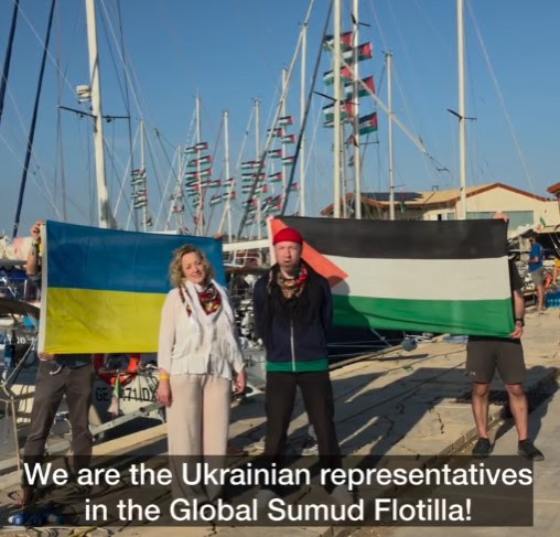
Israeli Navy's criminal attack on Gaza flotilla: Ukrainian team among detained crews. Release them all now!
The European Network for Solidarity with Ukraine (ENSU) has learned that the vessel carrying the Ukrainian team as part of the Sumud Global Flotilla 2026 was one of those illegally seized by the Israeli Navy early this morning.
According to an Al Jazeera report seven out of the 58 vessels were captured by Israel near Crete, over a thousand kilometres from the coast of Gaza.
ENSU coordinator Szymon Martys described the raid as "a blatant and cynical attack on unarmed vessels navigating peacefully in international waters”. He demanded the immediate release of the detained crews, which include the Ukrainian team of Nina Potarska and Andrii Movchan (pictured).
Martys said that ENSU, which is supporting the two Ukrainian peace and human rights activists, had no information as to their situation, but assumed that they, along with other crews, were being held illegally on an Israeli navy vessel.
"They must all be freed immediately", he added, and called on the Ukrainian government, along with the governments of all the kidnapped crews, to demand their immediate release. “ENSU also supports the demand that the Greek Coast Guard protect the flotilla, some of whose ships have had their engines disabled by the Israeli Navy.”


 The United States has grown wary of long term occupations. Abandoning the pretence of exporting democracy, the Trump administration has chosen to force existing powers to comply with its rule.




 As Israel ticks off its list of Nazi-like atrocities against the Palestinians, including mass starvation, it prepares for yet another – the demolition of
  Most of the recent electoral rounds in Western countries (lately in Norway and Germany) have yielded worrying results that confirm the rise of racist far-right forces. This buttresses the characterization of the era we live in as one comparable to the fascistic era between the two world wars of the past century, but in a new guise claiming to respect the democratic form of government, among other new features. Hence the labelling of these forces as neofascist (see “The Age of Neofascism and Its Distinctive Features”, 4 February 2025).

